Photo info
Description
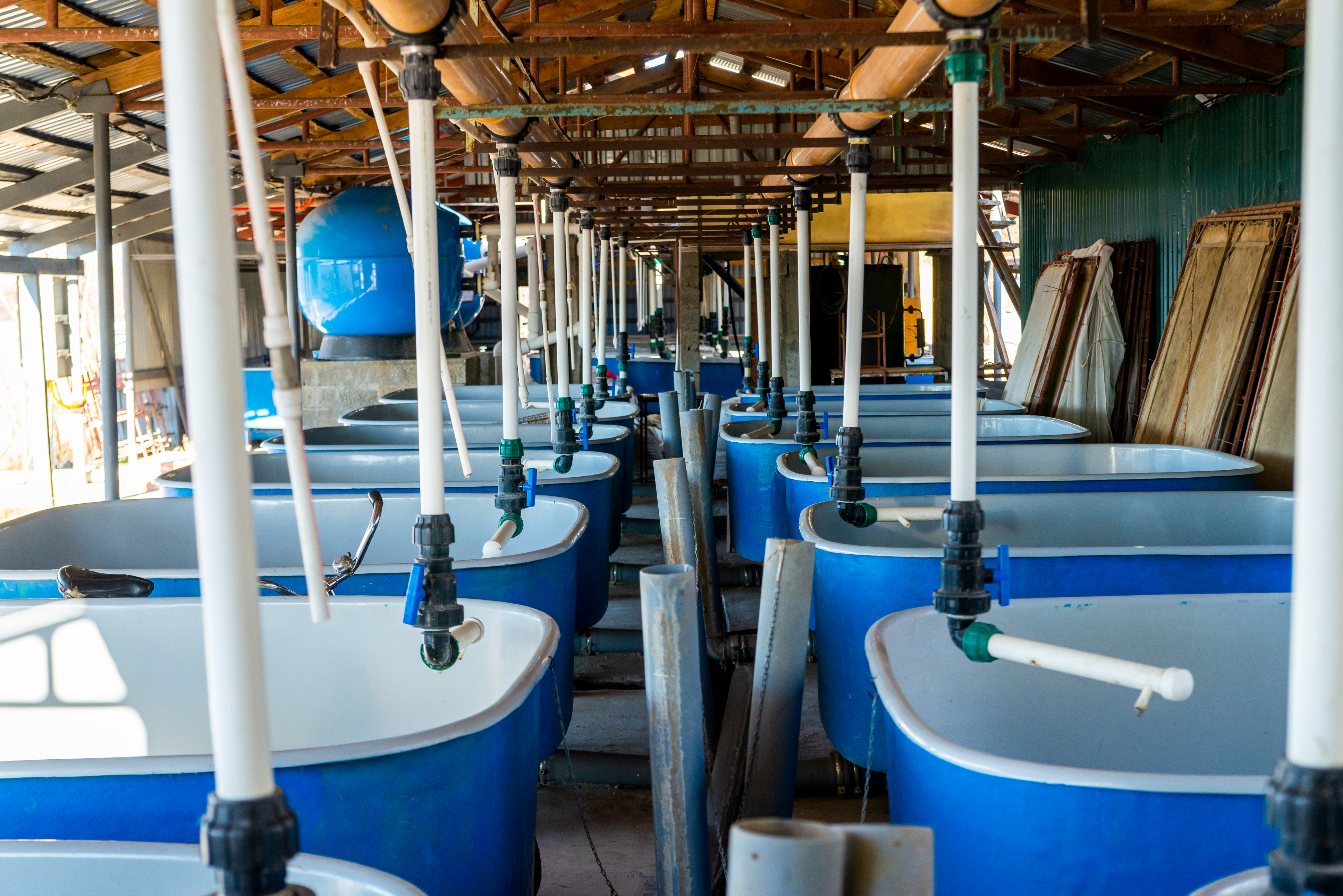
This image depicts an industrial aquaculture facility dedicated to sturgeon fish breeding. Rows of large, blue plastic tanks are arranged in neat lines under a corrugated metal roof structure, creating a rhythmic and orderly visual pattern that emphasizes the scale of commercial farming operations. The interior is illuminated by natural daylight filtering through gaps in the roofing, casting soft shadows and highlighting the texture of concrete flooring and wooden beams overhead. Each tank is fitted with white PVC pipes and black valves for water circulation and maintenance, indicating a sophisticated system designed for controlled aquatic environments. In the background, additional equipment such as large blue storage tanks and stacked wooden panels suggest ongoing operations and infrastructure development.
The composition features strong leading lines created by the rows of tanks converging toward the vanishing point, guiding the viewer’s eye into the depth of the facility. The dominant color palette consists of vivid blue tanks contrasting with neutral tones of concrete, metal, and wood. Textures range from smooth plastic surfaces to rough corrugated roofing and weathered wooden planks leaning against walls. Lighting is diffused yet directional, with sunlight creating bright highlights on pipe joints and tank edges while casting deep shadows under the roof’s eaves. The presence of multiple identical tanks reinforces a sense of repetition and industrial uniformity.
The atmosphere evokes a blend of functional efficiency and quiet industriousness characteristic of modern aquaculture operations. There is no visible human activity, which enhances the feeling of mechanical precision and automated management. The scene conveys both practicality and aesthetic order — the clean lines, color contrast, and geometric arrangement lend an almost architectural quality to this agricultural setting. This image captures not just a place for fish breeding but also a testament to technological innovation in sustainable food production. It invites contemplation on the intersection of nature, industry, and human ingenuity within controlled environments.
The composition features strong leading lines created by the rows of tanks converging toward the vanishing point, guiding the viewer’s eye into the depth of the facility. The dominant color palette consists of vivid blue tanks contrasting with neutral tones of concrete, metal, and wood. Textures range from smooth plastic surfaces to rough corrugated roofing and weathered wooden planks leaning against walls. Lighting is diffused yet directional, with sunlight creating bright highlights on pipe joints and tank edges while casting deep shadows under the roof’s eaves. The presence of multiple identical tanks reinforces a sense of repetition and industrial uniformity.
The atmosphere evokes a blend of functional efficiency and quiet industriousness characteristic of modern aquaculture operations. There is no visible human activity, which enhances the feeling of mechanical precision and automated management. The scene conveys both practicality and aesthetic order — the clean lines, color contrast, and geometric arrangement lend an almost architectural quality to this agricultural setting. This image captures not just a place for fish breeding but also a testament to technological innovation in sustainable food production. It invites contemplation on the intersection of nature, industry, and human ingenuity within controlled environments.
Resolution
3870 × 2583 pixels -
10.0 megapixels
Date
Oct 13, 2025
Category
Production